
A Reader's Guide to the Philanthropy Fight of 2026
Every major piece in the third-wave debate, what each one argues, and where the fight stands.
If you work anywhere near the social sector, fragments of this debate have been floating through your feed for four months. A viral essay here, a rebuttal there, a Buffett statement, a Thiel quote that made you wince.
And it isn't just playing out in essays. It keeps showing up in my private conversations too... with folks building inside the new AI philanthropy vehicles and across the AI-for-good circles I run in. Everyone is asking some version of the same question: is this money real, and who gets to spend it?
So I went back and read everything.
This is the whole map in one read... every major piece, what each one actually argues, and where the fight stands now. Grab a coffee. There's a lot of money on the table.
How it started
In mid-March, the New York Times reported that the Giving Pledge... the 2010 Buffett-Gates initiative that got 250+ of the world's richest families to commit half their wealth to giving... was facing open revolt. Sign-ups had collapsed. Brian Armstrong of Coinbase fame quietly unsigned. Larry Ellison amended his pledge to include for-profit ventures. And Peter Thiel told the Times he'd been privately urging signers to walk away, calling the whole thing an "Epstein-adjacent, fake boomer club."
Buffett pushed back publicly, calling the Pledge "quite a success." Craig Newmark published his own NYT op-ed defending it and telling fellow tech founders to stop whining and give their money away (love Craig!)
I wrote about all this in March as the enshittification of philanthropy. The new Silicon Valley line... that building a business IS the philanthropy... Elon touts this. So does Bezos. It struck me then as a convenient philosophy for people who'd rather keep the money. It still does.
Then in May, the debate got a second act nobody expected.
The catalyst: Nan Ransohoff's "Third Wave"
On May 19, Nan Ransohoff, who leads climate work at Stripe, published The Third Wave of American Philanthropy and shook the entire sector.
Her napkin math: the OpenAI Foundation holds roughly 26% of OpenAI (~$220B at current valuation), Anthropic's seven co-founders have pledged 80% of their wealth, and Anthropic runs the most aggressive employee donor-matching program in tech history. Add it up and you get an estimated $37 billion in new annual giving... potentially up to $100 billion... against roughly $600 billion in total current US giving.
Her provocation wasn't the money. It was Belief 3: "Traditional philanthropic orgs and people won't cut it." She argues the sector lacks the talent and institutions to absorb this wave, calls for "a Silicon Valley for public goods," and says the next 12-18 months are decisive.
Nearly everyone who responded agreed on the scale. Almost nobody agreed on the rest.
The responses, mapped
Lyel Resner, How an AI Philanthropy Boom Could Fail Before It Starts. The response that got the most traction in my corner of the internet. Resner (MIT, Swayable co-founder) agrees the opportunity is massive but rejects the talent-shortage premise entirely: extraordinary talent and institutional knowledge already exist across the social sector. It's been underfunded for decades, not absent. Mistaking a funding drought for a talent drought means the boom fails before it starts... new money flows to new orgs run by people who look like the funders, while the people closest to communities get passed over again.
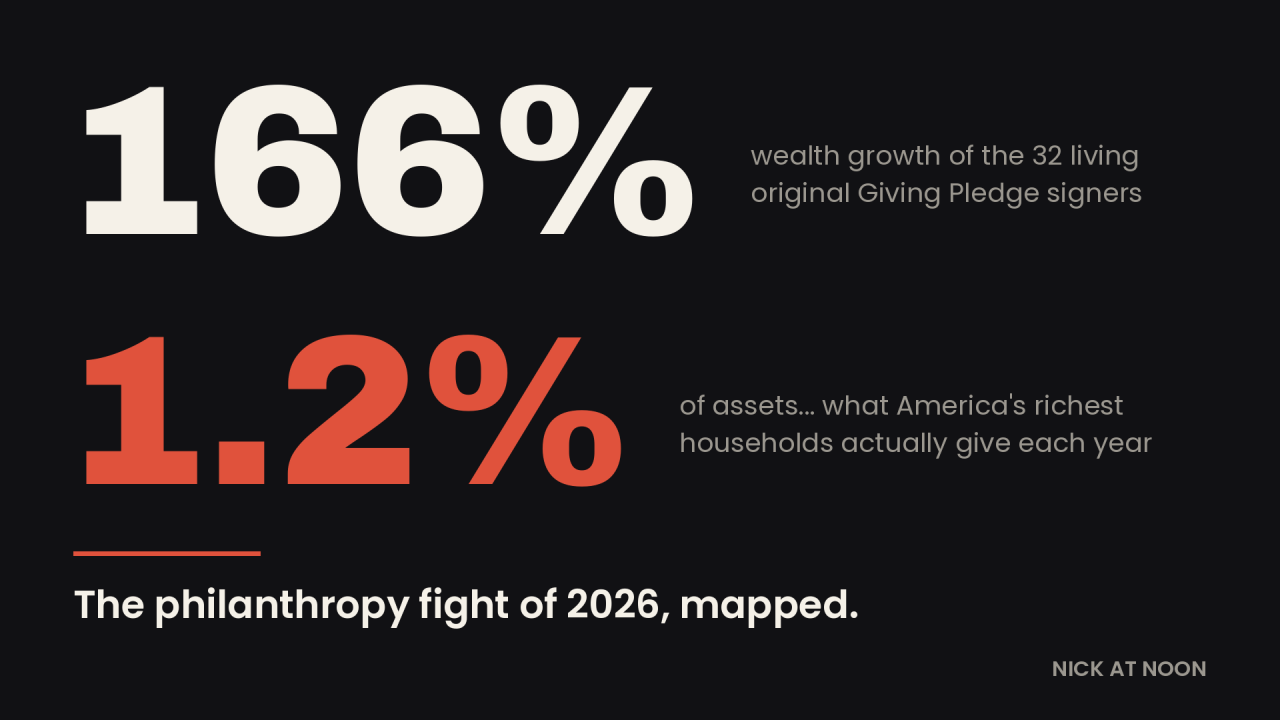
Nathan Chappell, The Third Wave Has a Blind Spot. Chappell is one of the most pro-AI voices in the nonprofit world, which makes his rebuttal sting. His receipts on the last wave of pledged wealth: the 32 living original US Giving Pledge signers have grown roughly 166% wealthier since signing. About 80% of what they've given sits in private foundations and donor-advised funds rather than working charities. Only one living couple from the 2010 cohort has been identified as actually fulfilling the commitment. His summary: promises are not capital. And Wave 3 funders' wealth depends on broad AI adoption, so watch the incentives.
Jeff Bradach, Slow Philanthropy (Bridgespan). The Bridgespan co-founder's late-July essay is the most sobering entry, because it's the least polemical. His data: US households with $500M+ in assets have given a flat 1.2% of assets annually for years, even as their wealth exploded. Half of America's roughly one thousand billionaires are 70 or older, so enormous money will flow somewhere soon... but Bradach says it feels less certain than it did 15 years ago that it flows into philanthropy at all. His direct warning: third-wave hopes "may be dashed if philanthropy continues on its current trajectory."
Cat Ward (Taproot Foundation), A Third Wave of Philanthropy Is Coming. Here's How To Not Waste It (Forbes). Ward's frame is the one I keep quoting: the difference between transformation led from within, by people who know the work, and disruption imposed from outside by funders who just arrived. The sector isn't empty or under-talented... it's full of experienced professionals holding together a chronically underfunded system with both hands. She also asks the question the equity-compensation crowd skips: pay top allocator talent in Anthropic stock, sure, but what about the caseworker? One in five nonprofit workers lives in a household experiencing financial hardship.
Michelle Flores Vryn, $100 Billion in AI Philanthropy Sounds Great! Think Again (Chronicle of Philanthropy). The most fundamental challenge in the pile. Her question: is the assumption that more money equals more good simply wrong? The wealth being deployed is part of the very system we're trying to repair. Tech has never been good at solving problems outside its own field of vision, and the answer may require something slower than "rapid philanthropic deployment"... funders willing to be changed by encounters with inequity in their own backyards, as citizens rather than donors.
Jennifer Pahlka, Philanthropy's Willie Sutton Problem. The Code for America founder takes the debate somewhere nobody else does: government. Third-wave money will have to work with government, and more importantly ON government... fixing the "slow and rickety policy apparatus" itself. If new funders replicate Silicon Valley's aversion to the public sector, they'll cap their own impact no matter how fast their grantees move.
David Wallace-Wells (New York Times). Wallace-Wells raises the power question directly: a wave of AI philanthropy at this concentration could look less like generosity and more like a grab for control over public life. Worth sitting with, especially alongside the March backlash story.
Craig Shapiro, Philanthropy's Other Third Wave (Collab Fund). The most sympathetic-to-tech entry, and the strongest version of the "business is the vehicle" argument. Shapiro agrees with Ransohoff on the institutional mismatch but argues some of the biggest problems of the next 50 years will be solved by companies never asked to choose between profit and progress in the first place. He points to Stripe's new $500M Intercept Fund (which he advises) as one model. Read it as the steelman of the position Thiel holds cynically.
Sjir Hoeijmakers, The Third Wave of Philanthropy Needs a New Marketplace. Hoeijmakers flips Ransohoff's core worry. Spending an extra $50B a year won't be hard... US philanthropy grew by $30B last year alone. The hard part is avoiding the incentives that usually guide expansion: catering to donor preferences and vanity metrics like "dollars deployed" instead of actual changes in beneficiaries' lives.
Inside Philanthropy, Are AI Donors Unicorns? The reality check. If anyone represents the give-it-all-away AI winner Ransohoff imagines, it's Dustin Moskovitz and Cari Tuna, who signed the Pledge 15 years ago and built the institution (now Coefficient Giving) she cites throughout her piece. IP's review of their foundation's actual filings suggests even the best-case donors move money slower and messier than the projections assume.
Where the fight actually is
Four months in, the real disagreements have sharpened into a handful of questions:
- Will the money actually move? Ransohoff assumes ~10% annual deployment. Bradach's data says the ultra-wealthy have given a flat 1.2% for a generation. Chappell says promises aren't capital. This is the empirical question everything else hangs on.
- Is the constraint talent or funding? Ransohoff says the sector can't absorb the wave. Resner and Ward say the sector was starved, not empty. Whoever wins this framing decides where billions go... new orgs vs. existing ones.
- Who gets to hold the money... nonprofits, new philanthropic startups, or companies? Shapiro's companies-as-vehicle case is the honest version of an argument that's mostly been made in bad faith since March.
- What about power? Wallace-Wells, Flores Vryn, and Pahlka are all circling the same discomfort from different angles: concentrated giving at this scale shapes public life whether or not it's generous.
- And underneath it all: the values question. The most-liked comment on Nan's own piece said it best... philanthropy is a function of values, not wealth. The Giving Pledge backlash and the third-wave optimism are the same story told in two moods.
Two things I'll say now (more in the next article)
First: the pieces that moved me most were the ones with receipts. Bradach's 1.2% and Chappell's 166% tell you more about what will happen than any manifesto about what should.
Second: almost every piece above treats "pledged capital" and "structural capital" as the same thing. They're not... and in my conversations with people building inside these new vehicles, that distinction is the one that keeps surfacing. It's where this debate goes next, and it's the follow-up post.
What did I miss? This debate has been sprawling across Substack, LinkedIn, the trades, and the NYT for four months, and I'm sure there are strong pieces that didn't cross my feed... drop them in the comments and I'll add them to a running list.
Sharing is CARING.
First published on LinkedIn, August 12, 2026. Read the original and the comment thread there.
The $100 Billion Argument
A running reader's guide to the fight over AI wealth and philanthropy: what the companies say, what everyone else is saying, and Nick's take. Newest first.
Also open right now
- Mozilla Foundation Human-Scale AI Incubator — up to $500K over three years, global, closes Nov 20, 2026
- Cities Deliver: AI Solutions for Public Services — $500K–$2M, global, city partner required, closes Nov 29, 2026
- Mozilla Foundation Fellowship 2027–2028 — up to $125K over 12 months, global, letter of intent due Dec 17, 2026
- Responsible Computing Challenge 2026 (US) — Mozilla and Mellon, up to $125K for US higher-ed faculty teams, LOI window open until Jan 6, 2027
- Anthropic Claude Corps — placed fellow + $10K for US nonprofits, applications open
- AI for Good Innovation Factory 2026-27 — ITU, $20K per finalist, accepting applications
- Impact AI Fellowship 2027 (HIIG) — €5,000, Berlin; reopens briefly after Nov 10 and 17 info sessions
Browse by type: grants, accelerators, fellowships, credits & compute, challenges. Browse by topic: AI for health, AI for climate, AI for education, Africa and the Global South. Or see all opportunities A–Z and filter the full index by focus, geography and deadline.
Don't miss the next one like this.
One email a month: the AI-for-good opportunities that just opened, the ones about to close, and where the money is moving. No spam, no filler.
Free. Unsubscribe anytime.
✓ You're on the list. First digest lands soon.