The Deadlines Arrived Before the Debate Ended
The IPO got a date, the OpenAI Foundation ran its second cycle, legacy foundations opened a rival fund, and the open calls piled up.
Quick catch-up if you're new to this series. In May, Stripe's Nan Ransohoff published an essay arguing that AI wealth from OpenAI and Anthropic could add up to $100 billion a year to American philanthropy, and that the social sector isn't built to absorb it. That set off months of argument. Part 1 mapped the first ten responses. Part 2 added the essays readers sent me and tracked the first real money moving.
Part 3 exists because the story stopped being theoretical. Since late August, the IPO got a reported date, the OpenAI Foundation ran its second full grant cycle, ten legacy foundations opened a rival fund, and the number of live application deadlines went from a trickle to a pileup. The argument is still running. The calendar stopped waiting for it.
The clock finally has a date
For four months, the most honest thing anyone could say about the third wave was that every projection sat downstream of liquidity events with no calendar attached. That's over.
Anthropic is reportedly targeting a Nasdaq listing in November, at a valuation that could reach $2 trillion, with the roadshow expected to begin mid-October. The Wall Street Journal reported the November plan on September 18, and Reuters has already covered details from the prospectus, including its proposed voting structure. Sam Altman, meanwhile, has said OpenAI won't list in 2026.
Hold the $2 trillion number up against the pledges. Anthropic's seven co-founders have committed 80% of their wealth. The company ran the most aggressive employee donor-matching program in tech. If this listing happens on anything like the reported terms, the question this whole series has been circling... will the money actually move?... starts getting answered with filings instead of forecasts, possibly within weeks of this post.
I'll have more to say about that in Part 4, after the listing. There's a distinction between pledged capital and structural capital that I think decides how this era gets remembered, and I'd rather make that argument when the numbers are real.
The checks got real, and the cadence picked up
While the debate ran, the OpenAI Foundation quietly turned into one of the most active funders in this space.
On October 1 it announced its second People-First AI Fund cohort: $50 million in unrestricted grants to 163 nonprofits across 35 states, selected from 1,669 open-call applications, with every grant disbursed before the end of the year. That's now two full annual cycles... last year's round moved $40.5 million to 208 organizations from nearly 3,000 applicants. Whatever you predicted in May about whether this foundation would actually run open calls, review every application, and wire unrestricted money on a schedule, there's now a track record to check it against.
September alone brought a voice initiative, a Public Data for Health program, and an AI forecasting project for smallholder farmers. And the one I'd flag for this audience: Horizon 1000, a $50 million pilot with the Gates Foundation to strengthen primary healthcare across 1,000 African clinics, beginning in Rwanda. Part 2 noted that the Foundation's open calls were US-only and that nothing was flowing to low- and middle-income countries. Horizon 1000 is the first serious counterexample, and it's worth saying so plainly.
One governance detail for the close readers: OpenAI's new $5 million teen-development research grants are funded by OpenAI Group PBC, the company, not the Foundation. The money is already moving through two different doors, which will matter for anyone trying to track it later.
Legacy philanthropy wrote its answer
The newest storyline isn't AI money at all. It's old money organizing a response.
Humanity AI is a coalition of ten of the most established names in American philanthropy... Ford, MacArthur, Mellon, Mozilla, Packard, Omidyar, Kapor, Doris Duke, Lumina, and Siegel... pooling $500 million over five years, with Rockefeller Philanthropy Advisors running the fund. Their first open call went live September 10: $10 million, grants of $75K to $1 million for up to three years, closing October 21. Kudos to John Palfrey, Beth Goldberg and team for this effort.
No AI literacy training. No projects promoting adoption of AI tools. No research without a community action component. They want work where the people most affected by AI set the agenda, with a stated preference for open-source models.
Put that next to the OpenAI Foundation's approach and you have two live, funded, competing theories of how this technology meets civil society. One says: get AI into the hands of trusted community organizations and let them figure out what it's for. The other says: fund communities to shape, govern, and when necessary challenge the technology itself. Both are running open calls in the same month. The sector gets to be the experiment.
The new takes worth your time
The essays haven't stopped either. Additions to the running list since Part 2:
Daniel Stid, Is It Time to Brace Ourselves for a "Third Wave" of AI Philanthropy? (The Art of Association). The civil society reading of the whole debate. Stid takes seriously the part of Nan's essay most responses skipped... her line about funding "aesthetics, civic life, moral imagination, relationships, and the cultural infrastructure that gives life meaning"... and asks what it would take for AI philanthropy to actually do that, rather than spending its first decade on the risks and costs of the AI transition. His answer is cautious: Americans may accept the intensive early focus on transition risks, but a wave that stops there isn't transformative, just defensive.
80,000 Hours, The Era of the Philanthropic Founder. The most build-something response yet. Their argument: everyone debated Nan's scale estimate and nobody engaged her proposed solutions. They profile a new founder archetype... people who could start companies but are instead starting philanthropically funded organizations to work on problems markets won't touch, with AI-era funding making that a viable career for the first time. If Resner and Ward argued the talent already exists in the sector, this is the case that new talent is arriving anyway.
Devex, Major AI Money Could Be Coming. How Can Nonprofits Prepare? Two lines from this piece stand out. Alexander Berger, who spent years helping Dustin Moskovitz and Cari Tuna deploy billions, says nonprofits should be building their "absorptive capacity" now... evidence-backed funding opportunities with a credible plan for using significantly more money. And Sheila Warren's description of the whole moment: "We're in a vibes-based environment." Evidence alone won't get you on these donors' radar. Both things are true at once, which is the uncomfortable part.
Robyn Bennett, A Silicon Valley for Public Goods? A June piece I missed in both earlier rounds, and readers kept sending it. Her frame: how we build matters more than how fast, and the speed obsession in Nan's three beliefs is itself a design choice with consequences.
And the institutions are forming while we talk. Renaissance Philanthropy has mobilized over $530 million into thesis-driven science and tech funds and launched an AI Talent Accelerator that embeds engineers directly into partner organizations. CGD's "Putting the AI Windfall to Work" series is continuing past the Glennerster and Rosenzweig opener. The allocator layer everyone said was missing is getting built in public.
What the ImpactOpen AI index is showing
Since ImpactOpen went live, we've been tracking this market one verified listing at a time, and a few patterns are worth reporting.
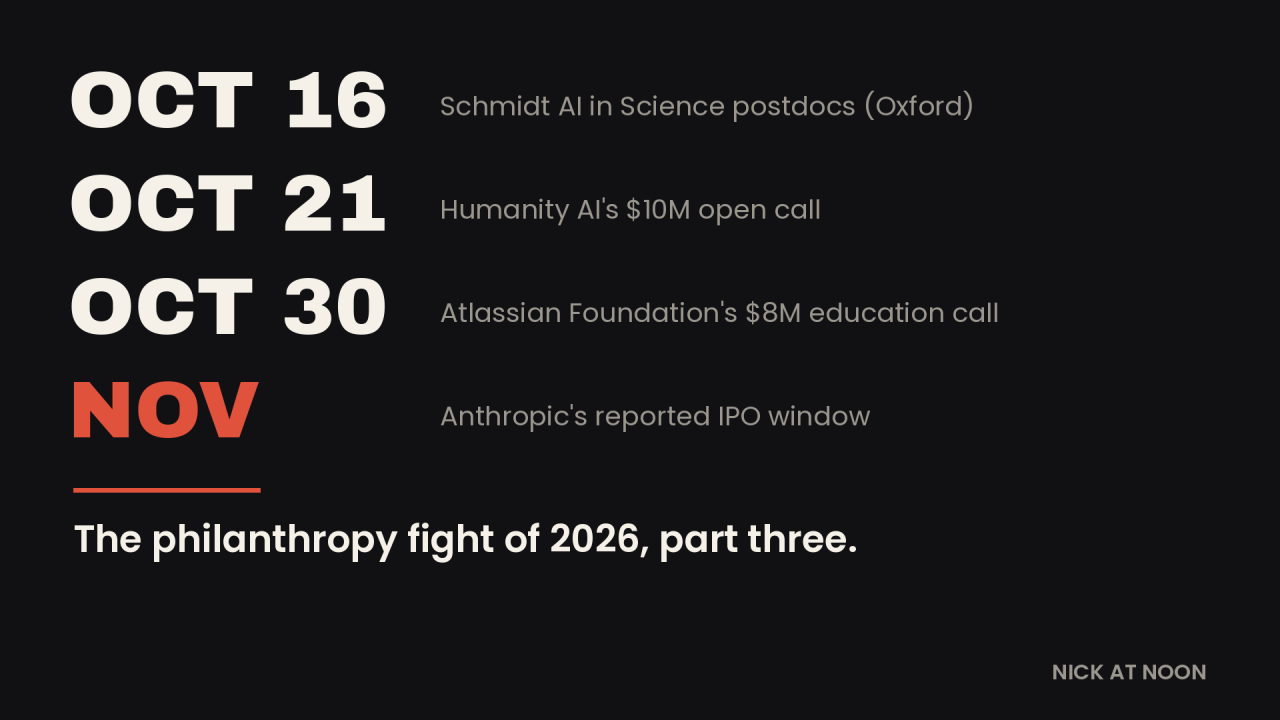
The deadline pileup is real. October alone: the Schmidt AI in Science postdoc at Oxford closes October 16, Humanity AI closes October 21, the Atlassian Foundation's $8 million education call closes October 30, and the Bias Bounty mapping challenge closes October 31. Citi Foundation launched a $25 million challenge on September 9... 50 grants of $500K each for youth workforce readiness across roughly 70 countries, one of the few global AI funds we've seen.
The cash-versus-credits split is visible now instead of theoretical. A meaningful share of what's open is compute, credits, and in-kind programs rather than money an organization can spend on salaries. Both matter. They are not the same thing, and we list them separately so you can see the ratio for yourself.
And the US-only pattern persists, with cracks forming. The biggest open calls still require US registration. But Horizon 1000, the Citi challenge, EVAH (a $60 million Gates, Novo Nordisk, and Wellcome initiative funding locally led evaluations of AI health tools, run through J-PAL), and the FCDO-IDRC AI4D program are real counterweight, and most of them didn't exist when this series started.
Everything above is on the index, filterable and downloadable, every deadline checked by hand. If you're sitting on an opportunity we've missed... especially funders in Asia, Africa, or Latin America... submit it and we'll verify and add it.
What did I miss this round? New essays, new funds, disagreements with any of it: send them and I'll keep the running list honest. Part 4 comes after the IPO, when we find out what a pledge is worth.
Sharing is CARING.
First published on LinkedIn, October 6, 2026. Read the original and the comment thread there.
The $100 Billion Argument
A running reader's guide to the fight over AI wealth and philanthropy: what the companies say, what everyone else is saying, and Nick's take. Newest first.
Also open right now
- Mozilla Foundation Human-Scale AI Incubator — up to $500K over three years, global, closes Nov 20, 2026
- Cities Deliver: AI Solutions for Public Services — $500K–$2M, global, city partner required, closes Nov 29, 2026
- Mozilla Foundation Fellowship 2027–2028 — up to $125K over 12 months, global, letter of intent due Dec 17, 2026
- Responsible Computing Challenge 2026 (US) — Mozilla and Mellon, up to $125K for US higher-ed faculty teams, LOI window open until Jan 6, 2027
- Anthropic Claude Corps — placed fellow + $10K for US nonprofits, applications open
- AI for Good Innovation Factory 2026-27 — ITU, $20K per finalist, accepting applications
- Impact AI Fellowship 2027 (HIIG) — €5,000, Berlin; reopens briefly after Nov 10 and 17 info sessions
Browse by type: grants, accelerators, fellowships, credits & compute, challenges. Browse by topic: AI for health, AI for climate, AI for education, Africa and the Global South. Or see all opportunities A–Z and filter the full index by focus, geography and deadline.
Don't miss the next one like this.
One email a month: the AI-for-good opportunities that just opened, the ones about to close, and where the money is moving. No spam, no filler.
Free. Unsubscribe anytime.
✓ You're on the list. First digest lands soon.