What's Changed in AI Philanthropy Since May
The essays readers sent, the numbers on pledged money, and the first $100 million grant.
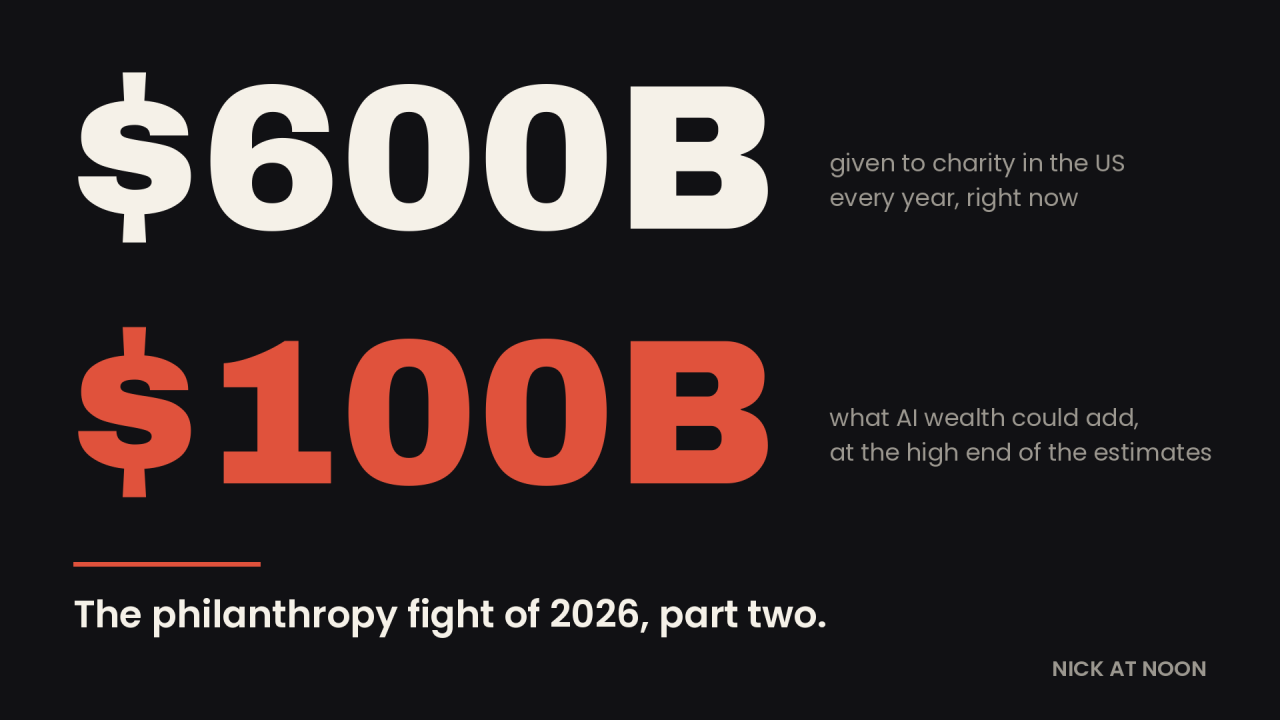
In May, Nan Ransohoff published an essay arguing that the wealth about to be created by OpenAI, Anthropic, and the people who work there could add tens of billions of dollars a year to American philanthropy... possibly as much as $100 billion, against roughly $600 billion given in the US today. She also argued that the existing social sector isn't built to absorb it.
The essay set off four months of argument across Substack, the trades, Devex, and the New York Times. A couple of weeks ago I pulled the major responses together in one place, because I couldn't find anyone who had: who was arguing what, which claims had data behind them, and where the real disagreements sat. That's Part 1.
Then the comments did something better than the piece did. Readers sent essays I'd missed, questions none of the original ten pieces had asked, and at least one proposed metric I haven't stopped thinking about. Meanwhile the underlying facts moved... two IPO filings, a set of numbers on pledged money, and the return of a movement most people had written off.
So this is the update. Everything new and the ones that I missed.
The audit: what you added to the list
Nick Allardice, The Absorption Problem. The biggest miss from Part 1, and several of you flagged it. The GiveDirectly CEO is skeptical the $50B/year moves (he cites the same 1.2% base rate as Bradach)... but he's having dozens of conversations with the people who will be this wave, and the urgency is real enough that he expects giving well above the historical rate. His sharpest line is about accountability: when philanthropy fails at scale, almost nobody finds out. A for-profit that scales badly gets told by the market. A charity just keeps going.
JVS Bay Area in Fortune, AI's New Millionaires Want to Disrupt Philanthropy. They Should Fund What Already Exists. Thanks to Alana Ramo for this one. The rebuttal to "the sector can't absorb it" comes with the best receipts yet: 1.8 million US nonprofits already deploy roughly $600 billion a year, and the absorption question has literally been tested. MacKenzie Scott has moved $26 billion in large unrestricted gifts since 2019, and the Center for Effective Philanthropy's multi-year study found 90% of recipient organizations reported stronger finances, expanded programs, and reduced burnout. The experiment ran. We have the data.
Brad Smith, $50 Billion a Year That Answers to No One. Names the thing several Part 1 pieces circled: philanthropy at this scale is an unaccountable public good. That's not a bug to manage, he argues. That's THE problem.
AI Gov Lab, Democracy and a Third Wave of American Philanthropy. Extends the Wallace-Wells and Pahlka thread... what concentrated AI giving means for democratic governance, not just for nonprofits. Hat tip Joanna Wisniecka.
Katie Boland and Brian Boland (Delta Fund). Brian's comment on my post was basically its own essay, and their writing goes further: even when AI money lands in a foundation or DAF, a tiny fraction is ever deployed into real-world interventions... the rest sits invested, often in the very systems that accelerate the problems the foundation exists to grant against. At US taxpayer cost. Wendy Chamberlin is right that this deserves more room in the debate than I gave it.
Nathaniel Heller, Surfing the Third Wave of Philanthropy: Some Practical Guidance (Geneva Global). My good friend Nathaniel promised this in the comments and delivered. Heller's analogy is the one I'll be stealing: philanthropy trends are fad diets. Fifteen years ago it was the Giving Pledge, a decade ago DAFs, five years ago MacKenzie Scott, now AI money. Each has a kernel of truth and each gets hyperbolized. If the earlier waves were low-fat and paleo, AI wealth is the high-protein craze... helpful, not magic. He sides with Allardice that payout rates land closer to the floor than the ceiling, because humans are humans. What makes his piece different from everything else on this list is that it's operational. Three rules for nonprofit leaders and boards: don't let anticipated AI wealth distract you from the donors you already have, bring real evidence on cost-effectiveness (especially for EA-aligned funders), and treat this as an addition to a diverse pipeline rather than a substitute for one. He also names the deeper bias underneath the "AI donors do philanthropy better" claim... a Silicon Valley digital utopianism that traces back through Stewart Brand and the Whole Earth network, for which he recommends Fred Turner's "From Counterculture to Cyberculture."
Rebecca Sharp, Tony Senanayake, and Mallika S. in Devex. Published last week, and it reframes the whole funding question in three words. The IDinsight team's argument: technologists focus on what AI COULD do, the technical ceiling. Global development practitioners focus on what AI WOULD do, since adoption is set by institutions, regulation, and human behavior rather than capability. Almost nobody is working the third layer... what AI SHOULD do, meaning the values, guardrails, and hard calls about who benefits and who carries the risk. Philanthropy is getting very good at Could. Skip Would and Should and you fund a lot of impressive things that never get adopted, or that hurt the communities they were built for.
Two responses to that piece deserve amplifying. Dr Rahul Mathew: the real risk is funding AI that can scale before funding the institutions capable of governing that scale. And Kcevin Rob makes Should concrete... it isn't only ethics, it's a capital-structuring question about who takes first-loss, who's protected, who's accountable.
Rachel Glennerster and Leah Rosenzweig, We Can Spend $50 Billion a Year Effectively (Center for Global Development). The most concrete answer yet to "can the sector absorb it," from CGD's president no less. Their opening move reframes the number: $50 billion a year is what the US government disbursed in foreign aid in 2025, and India alone spends roughly $210 billion a year on social protection. Unprecedented it is not. Then they do what nobody else in this debate has done... publish an actual sample allocation. IRC scaling severe wasting treatment to 10 million children a year. Gavi absorbing $4-5 billion on malaria vaccines alone. Teaching at the Right Level catch-up programs for every child in school who can't read. Their conclusion cuts at the startup instinct directly: building new orgs is inevitably slow, and using existing large-scale implementers delivers impact faster and more durably. It's the first in a CGD series on putting the AI windfall to work, so more is coming.
Morgan Fairless and Benjamin Gaskill, What If the Third Wave Is a Puddle? (EA Forum). The best-argued skeptical piece, and it comes from inside the movement most likely to benefit. Their warning is about memory: it has not been long since a philanthropic movement had the floor pulled out from under it. The FTX collapse taught the EA world not to over-rely on one donor or a narrow set of them, and they see eerie similarities between that era's expectations and 2026's. They also make a point I hadn't considered... all the attention and courting of this small group may itself be creating a self-fulfilling cycle. A more modest third wave puts us in trickle territory, and a slow progressive increase warrants far less chin-stroking than the discourse suggests.
Devon Fritz, The Grown-Ups Aren't Coming. And credit where I owed it in Part 1: the Inside Philanthropy piece I cited, "Are AI Donors Unicorns?", is Michael Kavate's.
What changed while we were arguing
Two things happened during these four months that most of the essays above were written before, and they cut in opposite directions.
The IPOs got closer, and no closer. Anthropic confirmed on June 1 that it had confidentially submitted a draft S-1, days after a $65 billion round valuing it at $965 billion. OpenAI followed on June 8, at roughly $852 billion, with a statement I keep rereading: they submitted it, they expected it to leak so they announced it, and they have not decided on timing... it may be a while, because some things are easier as a private company.
Read that against the whole third-wave thesis. A confidential draft is an option, not a date. Neither company has set a share count, a price, or an exchange. Reuters reported in late June that OpenAI may wait until 2027, and its CFO has told people the same. Analysts cited by Wired put Anthropic's downstream effect at around $15 billion a year in new giving, roughly a 2.5% bump in total US giving from one company... but every projection in this debate, including that one, is downstream of liquidity events that currently have no calendar attached.
And the money is showing up as pledges first. Founders Pledge's numbers are the clearest signal anyone has produced: new pledged value went from just over $400 million in 2023, to $600 million in 2024, to $1.2 billion in 2025, to more than $4 billion in the first six months of this year. AI founders are now their largest category, over a third of all pledged value. Anna Tong's Forbes piece follows that money to an unexpected place... animal welfare advocates who see a rare opening.
Semafor and the FT both ran pieces this month on the same subject from the other end: effective altruism, left for dead after Bankman-Fried, is suddenly the movement best positioned to receive tens of billions. Whatever you think of EA (I want to like it but I'm so skeptical post SBF), it's the ideological infrastructure most of this capital was raised inside.
Two comment-thread contributions that belong on the record even though they aren't essays yet. Friend Wayan Vota proposed the best metric I've seen for whether any of this reaches anyone new: the share of dollars going to organizations the funder wasn't funding three years ago. Hard to game, easy to check. And other friend Matthew Guttentag named the fallacy under the talent debate: attributing failures of a system to the people working inside it, same as the lazy story about government bureaucrats.
The money has started to move. Watch how.
On August 13, the OpenAI Foundation committed $100 million to the Common Health Coalition for an initiative called Breakthroughs to Follow-Through. The goal is to at least double hepatitis C cure rates in eight states and jurisdictions within two years, starting with Alabama, Illinois, Louisiana, and Massachusetts, then extending to HIV prevention and curable cancers. Effective hep C drugs cure more than 95% of cases in eight to twelve weeks, and roughly two-thirds of Americans with the virus still aren't treated. That gap is a delivery problem, which is exactly the kind of problem this money should be good at.
I think it's a good grant. I also want to point at its shape, because the shape is the story.
It didn't go out through an open call. It went to an established national coalition founded in 2023, with named states attached, announced fully formed. Same for the Foundation's new AI for Civil Society and Philanthropy division under Anna Makanju. Meanwhile the People-First AI Fund, which does run as an open call, required applicants to be US-based... a restriction that drew a fair amount of criticism for sending nothing to organizations in low- and middle-income countries.
Now apply Wayan Vota's metric from the Part 1 comments: what share of these dollars reached organizations the funder wasn't already funding three years ago? For B2F I can't tell you. Nobody can, because nobody is keeping that ledger.
If you run a health program in Nairobi, or a two-person nonprofit in Ohio, none of the ten essays above tells you whether any of this is reaching organizations like yours, when the next open call lands, or whether the link someone forwarded you expired in March. The argument is well mapped. The money is not mapped at all.
So I built a map. It's a running index of what's actually open in AI-for-good funding... grants, fellowships, accelerators, challenges, and yes, compute credits, tracked by deadline and checked by hand. Free. You're on it now: ImpactOpen.
Which funders belong on it that nobody thinks of, especially outside the US and Europe? And what would make you trust a list like this... verified deadlines, named program officers, past grantee lists, something I haven't considered? Tell me. The comments on Part 1 built most of this piece.
Sharing is CARING.
First published on LinkedIn, August 24, 2026. Read the original and the comment thread there.
The $100 Billion Argument
A running reader's guide to the fight over AI wealth and philanthropy: what the companies say, what everyone else is saying, and Nick's take. Newest first.
Also open right now
- Mozilla Foundation Human-Scale AI Incubator — up to $500K over three years, global, closes Nov 20, 2026
- Cities Deliver: AI Solutions for Public Services — $500K–$2M, global, city partner required, closes Nov 29, 2026
- Mozilla Foundation Fellowship 2027–2028 — up to $125K over 12 months, global, letter of intent due Dec 17, 2026
- Responsible Computing Challenge 2026 (US) — Mozilla and Mellon, up to $125K for US higher-ed faculty teams, LOI window open until Jan 6, 2027
- Anthropic Claude Corps — placed fellow + $10K for US nonprofits, applications open
- AI for Good Innovation Factory 2026-27 — ITU, $20K per finalist, accepting applications
- Impact AI Fellowship 2027 (HIIG) — €5,000, Berlin; reopens briefly after Nov 10 and 17 info sessions
Browse by type: grants, accelerators, fellowships, credits & compute, challenges. Browse by topic: AI for health, AI for climate, AI for education, Africa and the Global South. Or see all opportunities A–Z and filter the full index by focus, geography and deadline.
Don't miss the next one like this.
One email a month: the AI-for-good opportunities that just opened, the ones about to close, and where the money is moving. No spam, no filler.
Free. Unsubscribe anytime.
✓ You're on the list. First digest lands soon.